
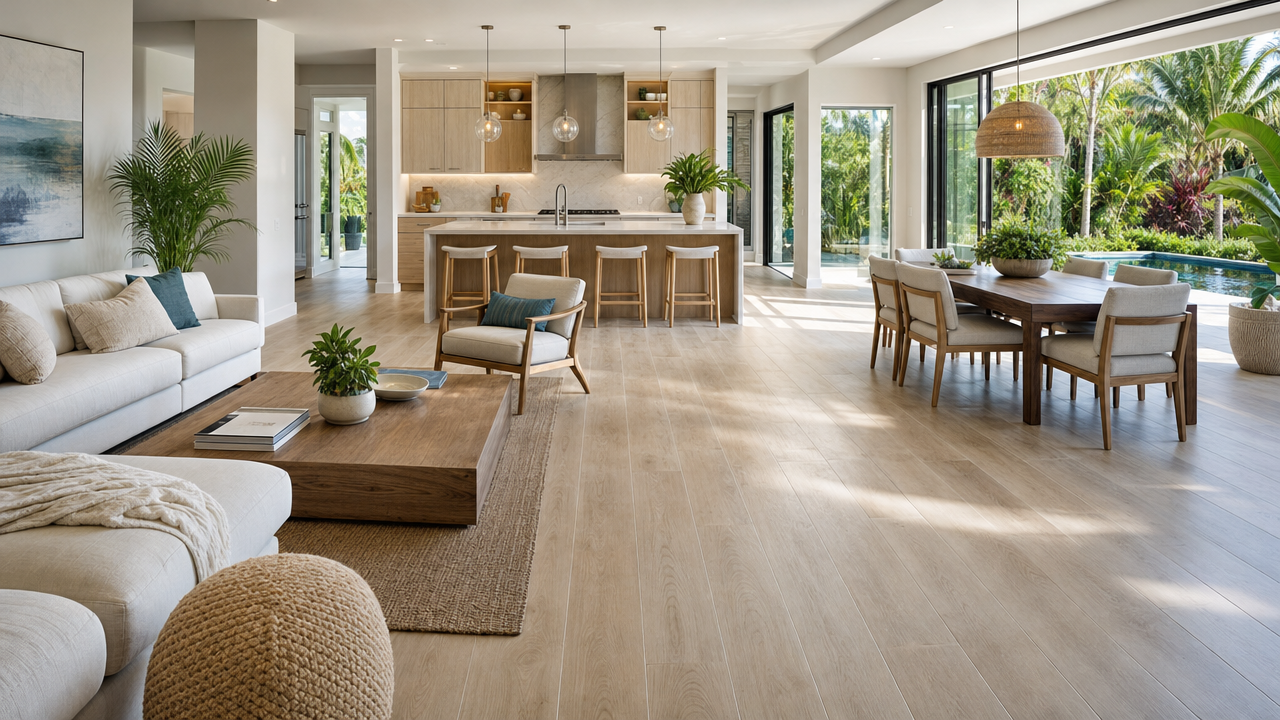
Flooring installation in Miami costs between $4,000 and $25,000 for a typical home project, depending on material and square footage. The right choice comes down to one number that shapes every decision in South Florida: humidity. Miami's average relative humidity runs 74 to 80 percent year-round, spiking to 90 percent in summer, and that single fact eliminates several flooring types before you ever look at a price tag.
What Miami's Climate Does to Your Flooring Options
Miami's humidity causes some flooring types to fail within a few years and lets others last a lifetime. When humidity swings from 90 percent in summer to around 60 percent in winter, solid wood planks warp, gap and buckle.
Standard laminate is not a good fit for Miami homes. Its composite core absorbs moisture from the concrete slab beneath it and breaks down from the inside out.
Miami homes are built mostly on slab-on-grade foundations. Concrete is porous, and moisture migrates upward through the slab into whatever flooring sits on top of it. This is why vapor barriers and proper underlayment are not optional here.
The flooring types that hold up well in Miami are SPC/LVP (stone plastic composite or luxury vinyl plank), large-format porcelain tile, and engineered hardwood when installed with a vapor barrier on the slab.
| Flooring Type | Humidity Performance | Miami Verdict |
|---|---|---|
| SPC/LVP | Excellent - 100% waterproof, dimensionally stable | Top choice |
| Large-format porcelain tile | Excellent - non-porous, 50+ year lifespan | Top choice |
| Engineered hardwood | Good with a proper vapor barrier on slab | Conditional |
| Solid hardwood | Poor - warps and gaps with seasonal humidity swings | Not recommended |
| Standard laminate | Poor - moisture penetrates composite core on slab | Not recommended |
| Carpet | Poor - humidity, allergens, buyer aversion at resale | Not recommended |
What Type of Flooring Is Best for a Florida Room?
For a Florida room, a screened or enclosed porch between interior and exterior, SPC/LVP is the strongest choice. Large-format porcelain tile is a close second. Both handle the extreme humidity and temperature swings a Florida room sees every day.
SPC/LVP is 100% waterproof and dimensionally stable, meaning it does not expand or contract with Miami's humidity swings. Its click-lock floating system also makes it easy to replace individual planks if damage occurs.
Porcelain tile is non-porous and unaffected by humidity. Its 50-plus year lifespan makes the higher upfront cost of roughly $11 per square foot installed a reasonable long-term investment for a Florida room.
Large-format tiles in 24x24, 24x48 and 32x32 inch formats have dominated Miami high-end residential design for the past decade. They need a very flat substrate and a skilled installer to avoid hollow spots and future cracking.
What Does Flooring Installation Cost in Miami?
A fair installed price for a 1,000 square foot Miami project runs $6,500 to $8,500 for LVP, around $11,000 for porcelain tile, or $4,000 to $7,000 for engineered hardwood before removal and subfloor prep.
Labor costs and timing
Miami flooring labor runs approximately 10 percent above the Florida baseline, which itself runs about 15 percent above the national average for hardwood installation. For hardwood, expect to pay $4.50 to $8.50 per square foot in labor alone in Miami.
Peak season in Miami runs January through April, when snowbirds arrive and renovation demand peaks. Labor rates during those months can run 5 to 10 percent higher than the rest of the year.
Removal and prep costs most quotes leave out
Old flooring removal adds real money to a project. Removing existing flooring costs $1.50 to $3.50 per square foot on average, but tile removal runs $2.00 to $7.00 per square foot. Carpet removal is the cheapest at $1.00 to $1.50 per square foot.
Subfloor issues are the biggest budget wildcard. If the slab or subfloor needs repair or leveling before installation, that work runs $3.00 to $10.00 per square foot. On Miami's slab-on-grade construction, this is not uncommon, especially in older homes where moisture damage has been working silently for years.
A realistic budget for a 1,000 square foot project that includes removal of old tile and installs new LVP looks like this: LVP material and installation ($6,500 to $8,500), tile removal ($2,000 to $7,000), subfloor prep if needed ($3,000 to $10,000). Total realistic range: $11,500 to $25,500.
| Flooring Type | Installed Cost (per sq ft) | Miami Climate Performance | Lifespan |
|---|---|---|---|
| SPC/LVP | ~$6.50 | Excellent - 100% waterproof | 20-25+ years |
| Large-format porcelain tile | ~$11.00 | Excellent - non-porous | 50+ years |
| Engineered hardwood | $4.00-$7.00 | Good with vapor barrier | 25-30 years |
| Solid hardwood | $6.00-$12.00 | Poor - warps in humidity | Not recommended |
| Exotic wood species | $8.00-$16.00 | Poor without vapor barrier | Varies |
Does New Flooring Add Value in Miami's Real Estate Market?
Yes, and the return on investment numbers are strong, especially for hardwood and LVP. Miami buyers expect hard surfaces. Carpet is considered a negative signal at resale in this market, where humidity, allergens and buyer preference for porcelain tile or quality LVP have made carpet uncommon in updated homes.
The NAR 2025 Remodeling Impact Report puts new hardwood flooring at 118% ROI and hardwood floor refinishing at 147% ROI at resale. Homeowners spend an average of $5,500 on refinishing and recover an average of $8,000.
Large-format porcelain tile has been the dominant aesthetic choice in Miami's high-end residential market for the past decade. For homeowners planning to sell within five years, flooring is one of the highest-ROI interior upgrades available.
| Flooring Type | Estimated Resale ROI |
|---|---|
| LVP/SPC | 70-100%+ |
| Porcelain tile | ~70% |
| Hardwood (new) | 118% (NAR 2025) |
| Laminate | Rarely adds value |
| Carpet | Negative in Miami market |
Do You Need a Permit for Flooring Installation in Miami-Dade?
In most cases, no permit is required for flooring installation in Miami-Dade County. Under Florida Building Code Section 102.2.5, flooring installation including carpet, tile, brick and wood surfacing is permit-exempt for single-family homes, duplexes, townhouses and condos. An aggregate limit of $5,000 per 12-month period applies for owner-builders and contractors working under this exemption.
Two conditions change this: if your project involves structural, electrical or plumbing work, permits are required for those scopes even though the flooring itself stays exempt. A kitchen remodel that includes new flooring and new plumbing lines requires a permit for the plumbing portion.
Condo owners need HOA or board approval before work begins, regardless of the county permit-exempt status. Building boards often have their own rules for noise mitigation materials, work hours and contractor credentials. Broward County homeowners should confirm the specific requirements with their local building department before starting any project.
How Flooring Installation in Miami Works, Step by Step
A Miami flooring project follows a sequence that differs from projects in drier climates because of the slab and humidity factors. Skipping steps, especially moisture testing and vapor barrier installation, is the leading cause of flooring failures in South Florida.
Step 1: Moisture testing and material selection
Before selecting a material, a qualified installer tests the moisture level of the concrete slab. That single measurement determines whether engineered hardwood is a viable option or whether LVP and tile are the safer choices.
Concrete is porous and releases moisture upward, especially in South Florida. If moisture readings are high, the contractor selects materials and vapor barrier products rated for those conditions.
If you have chosen engineered hardwood, the wood needs approximately one week to acclimate inside your home before installation begins, allowing the material to adjust to the home's ambient humidity. LVP/SPC does not require acclimation.
Step 2: Remove existing flooring and prepare the subfloor
Old flooring comes out first. Old tile, especially large-format ceramic or porcelain glued directly to the slab, can be slow and difficult to remove. Tile removal runs $2.00 to $7.00 per square foot.
Once the old floor is gone, the slab is ground flat, cracks are filled and high spots are leveled. Any subfloor damage runs $3.00 to $10.00 per square foot to repair. A flat substrate is required for large-format tile.
Step 3: Install the vapor barrier and underlayment
For any floor installed over concrete, LVP/SPC or engineered hardwood, a vapor barrier is installed directly on the slab before any flooring material is laid. The barrier blocks moisture from moving upward into the floor.
This step separates experienced South Florida installers from contractors who bring mainland practices that do not account for slab moisture. It is not optional.
Step 4: Install the floor
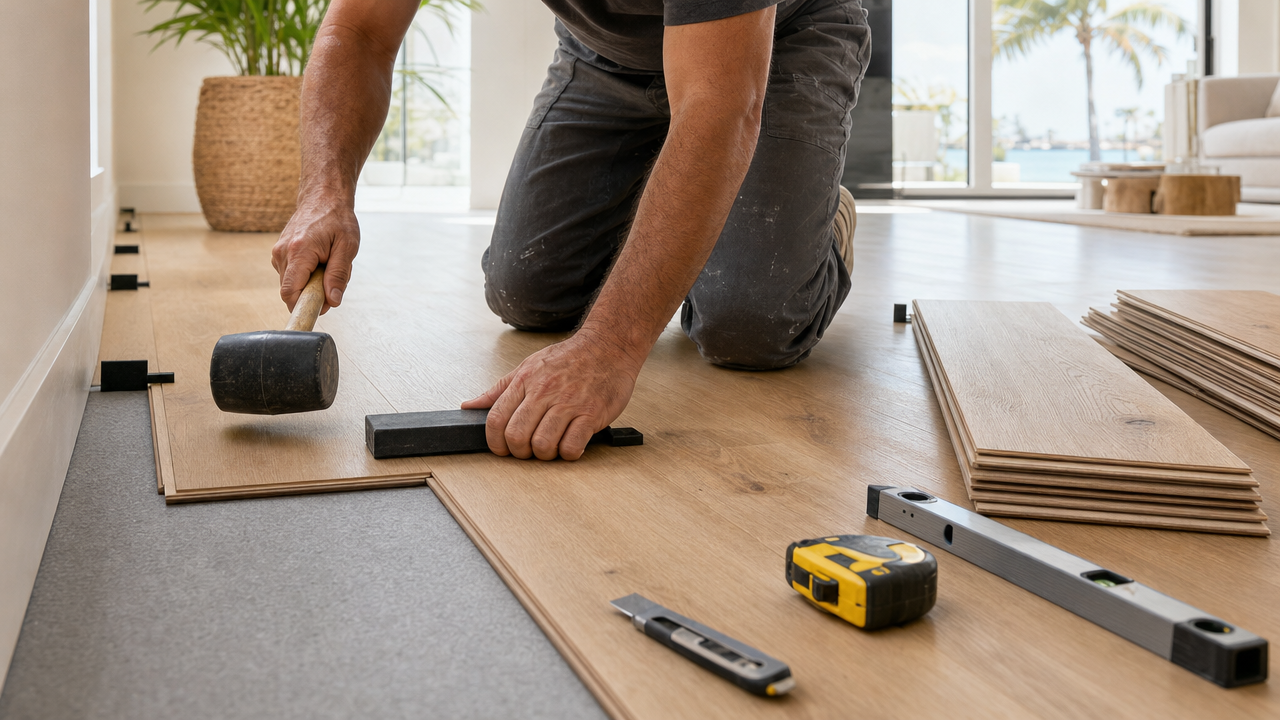
LVP/SPC uses a click-lock floating system. Planks lock together and float over the substrate without adhesive. Installation on a prepared slab typically takes one to two days for a standard residential space.
Large-format porcelain tile is set in mortar. The installer uses large-format tile setting materials to ensure full coverage behind each tile, which prevents hollow spots and cracking. Grout lines for modern large-format tile are typically very tight, which cuts grout maintenance but requires precise layout.
Engineered hardwood is either glued down directly to the slab or installed as a floating floor over underlayment, depending on the manufacturer's specification. Installation takes one to two days after the one-week acclimation period.
Step 5: Finish and inspect
Baseboards and transitions are installed or reinstalled. The installer cleans the floor and walks through the project with you to identify any areas that need attention. If you have installed tile, ask about grout sealing. Grout in South Florida should be sealed promptly given the humidity.
How to Choose a Flooring Contractor in Miami
The lowest bid rarely reflects the true cost once removal and subfloor prep are factored in. The local market includes flooring specialty shops and general contractors. If your project involves removing old flooring, repairing the subfloor, addressing moisture, or coordinating flooring as part of a larger renovation, a licensed general contractor handles all of it under one contract.
When evaluating anyone you invite to bid, look for a valid Florida contractor license, either a certified general contractor license (CGC) or a specialty flooring license, verifiable through the Florida Department of Business and Professional Regulation. Ask directly how they handle moisture testing. The answer tells you quickly whether they understand South Florida conditions.
Also confirm that the contractor handles removal, subfloor repair and installation under one contract. Familiarity with Miami-Dade permit-exempt processes and condo HOA submission requirements is a sign the contractor has worked in this market.
Royal Residence Builders (CGC #1538607) is a licensed general contractor serving Miami-Dade and Broward County. The company handles flooring, kitchen remodeling, bathroom renovations, home additions, roofing, impact windows and doors, interior and exterior painting, gutters, and driveways and hardscapes. Call (954) 737-2757 for a free estimate.
Key facts
- Miami's average relative humidity runs 74 to 80 percent year-round, spiking to 90 percent in summer. Source ↗
- Standard laminate composite core absorbs moisture from concrete slabs and should not be installed in high-moisture environments. Source ↗
- Concrete is porous and moisture migrates upward through slabs into flooring. Source ↗
- SPC/LVP is 100% waterproof and dimensionally stable in Miami's humidity. Source ↗
- Porcelain tile has a 50-plus year lifespan and is non-porous. Source ↗
- Large-format tiles (24x24, 24x48 and 32x32 inches) have dominated Miami high-end residential design for the past decade. Source ↗
- A fair installed price for a 1,000 square foot Miami LVP project runs $6,500 to $8,500. Source ↗
- Large-format porcelain tile costs around $11 per square foot installed in Miami. Source ↗
- Engineered hardwood costs $4,000 to $7,000 for a 1,000 square foot Miami project before removal and subfloor prep. Source ↗
- Miami flooring labor runs approximately 10 percent above the Florida baseline. Source ↗
- Peak season in Miami runs January through April, with labor rates 5 to 10 percent higher than the rest of the year. Source ↗
- Removing existing flooring costs $1.50 to $3.50 per square foot on average, with tile removal at $2.00 to $7.00 per square foot. Source ↗
- Carpet removal costs $1.00 to $1.50 per square foot. Source ↗
- Subfloor repair or leveling costs $3.00 to $10.00 per square foot. Source ↗
- Carpet is considered a negative signal at resale in Miami's real estate market. Source ↗
- The NAR 2025 Remodeling Impact Report shows new hardwood flooring delivers an estimated 118% ROI at resale. Source ↗
- The NAR 2025 Remodeling Impact Report shows hardwood floor refinishing delivers an estimated 147% ROI at resale, with homeowners spending an average of $5,500 and recovering an average of $8,000. Source ↗
- LVP/SPC returns 70 to 100 percent or more at resale. Source ↗
- Flooring installation including carpet, tile, brick and wood surfacing is permit-exempt in Miami-Dade County for single-family homes, duplexes, townhouses and condos under Florida Building Code Section 102.2.5, with a $5,000 aggregate limit per 12-month period. Source ↗
- Condo owners need HOA or board approval before flooring work begins, regardless of the county permit-exempt status. Source ↗
- Engineered hardwood requires approximately one week of acclimation inside the home before installation begins. Source ↗
Frequently asked questions
What type of flooring is best for a Florida room?
SPC/LVP is the top choice because it is 100% waterproof and dimensionally stable in Miami's humidity. Large-format porcelain tile is a strong second option for homeowners who want a 50-plus year lifespan. Engineered hardwood is possible in an enclosed Florida room with a vapor barrier, but carries more risk than LVP or tile in spaces exposed to outdoor humidity.
What is a fair price to install flooring in Miami?
For a 1,000 square foot project, expect $6,500 to $8,500 for LVP installed, around $11,000 for porcelain tile, and $4,000 to $7,000 for engineered hardwood as of 2026. These figures account for Miami's labor premium but do not include old flooring removal or subfloor repairs, which can add $1.50 to $10.00 per square foot depending on what is found underneath.
Do I need a permit to install new flooring in Miami-Dade?
Generally no. Flooring installation is permit-exempt in Miami-Dade for single-family homes, duplexes, townhouses and condos under Florida Building Code Section 102.2.5, with a $5,000 aggregate limit per 12-month period. Permits are required if the project involves structural, electrical or plumbing work. Condo owners need written HOA board approval regardless of the county exemption.
Why is solid hardwood not recommended in Miami?
Miami's humidity swings from roughly 90% in summer to 60% in winter. Solid hardwood expands and contracts with those swings, causing warping, gaps and buckling. Engineered hardwood handles it better because its cross-ply construction resists movement, but even engineered hardwood requires a vapor barrier on Miami's concrete slabs.
Is carpet a bad choice for Miami homes?
For most Miami homeowners, yes. Carpet is considered a negative signal at resale, and humidity and allergens make it a poor fit for South Florida's climate. Hard surfaces like LVP, tile and engineered hardwood are the standard expectation in updated Miami homes.
How long does flooring installation take in Miami?
LVP takes one to two days for a standard living area. Hardwood requires approximately one week of acclimation before installation, then one to two additional days to install. Large-format porcelain tile typically takes two to four days for a living area, depending on project size and layout complexity. Old flooring removal and subfloor prep add time to any of these.
What is the Rule of 3 for flooring?
The Rule of 3 is a design guideline recommending no more than three different flooring types in an open floor plan. Using more than three materials in connected, visible spaces creates visual fragmentation and can hurt a home's perceived cohesion at resale.
Sources
- Flooring types for Southwest Florida and the Suncoast ↗
- Choosing the best flooring for the Florida climate ↗
- Best flooring options for humid climates ↗
- Best flooring for South Florida homes ↗
- Flooring cost in Florida ↗
- Cost to install hardwood floors in Miami, 2026 ↗
- Flooring installation cost ↗
- Miami home renovations boost resale value local ↗
- Does new flooring increase home value ↗
- Flooring impact on resale value ↗
- Miami-Dade permit information ↗
- What permits required for home remodeling Miami-Dade ↗
- Hardwood flooring installation Miami costs ↗